In draft

We are rebuilding this site in the open. Pages arrive as they are ready, and the most useful things for parents come first. If a corner looks unfinished, it is.

Home / Evidence

Claims are cheap. Here is the work.

The Evidence Room

What our learners were actually asked, and what they actually made.

Each entry below is a real project: the question a facilitator put to the class, the thing the learners produced, and what was noted afterwards — including the failures, which our parents tend to remember longest. Filter by subject.

12 projects

Grade 8 · Science

“Can we build an air purifier that actually works — and prove it?”

A DIY purifier tested against five hypotheses, with CADR, CFM, static pressure and PM2.5 all measured. Having built a working machine, the learners were then made to argue how it could still fail: too noisy, too costly to maintain, impossible to repair locally, dependent on a filter nobody nearby stocks. The three-fan configuration and the open, repairable body were their own decisions.

Later taken out of school to a university Department of Electrical Engineering. Written up by Krishna Purohit, facilitator — including the measurements that contradicted the team’s first idea.
Grade 10 · Enterprise

“People sort waste wrongly. Can you remove the decision instead of teaching it?”

SegreSmart — a bin with a sensor module mounted on the central divider that makes the wet-or-dry decision for the user. Dry on one side, wet on the other.

Pitched nationally at LaunchVerse, August 2026, among India’s Top Schools.

Grade 10 · Enterprise

“Does sound change how fast microbes grow?”

An incubator with built-in music at set frequencies to aid microbial growth. Filed as a patent through the Summer Patent School at Shoolini University — prior-art search, AI tools, the legal framework, all of it.

The programme supplied the mechanism. The question was already hers, from earlier work on microbial growth.

Grade 9 · Design

“Design a chair. Then actually build it.”

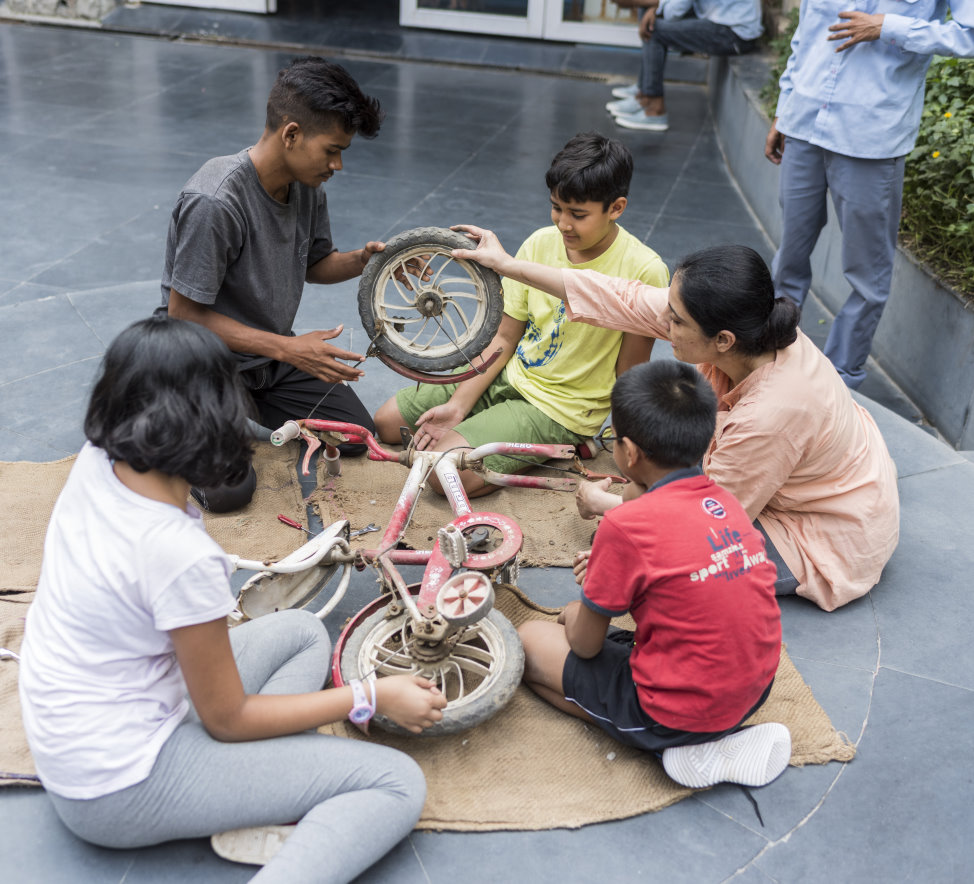
A chair, made in a carpenter’s workshop with real tools and real consequences.

It came apart in the workshop and stayed in pieces for ten minutes. Priyanka Kaur Oberoi, who set the assignment, published an account of exactly that — because that was when the learning happened.

Grade 5 · Civic

“What is actually wrong in your own neighbourhood?”

The Noida Project — every learner identified a problem they had personally observed, and wrote to the District Magistrate about it.

The unit was designed around field visits. Extreme heat made stepping outdoors impossible and they were cancelled. Nandini Singhal published that account too.

Grade 8 · History

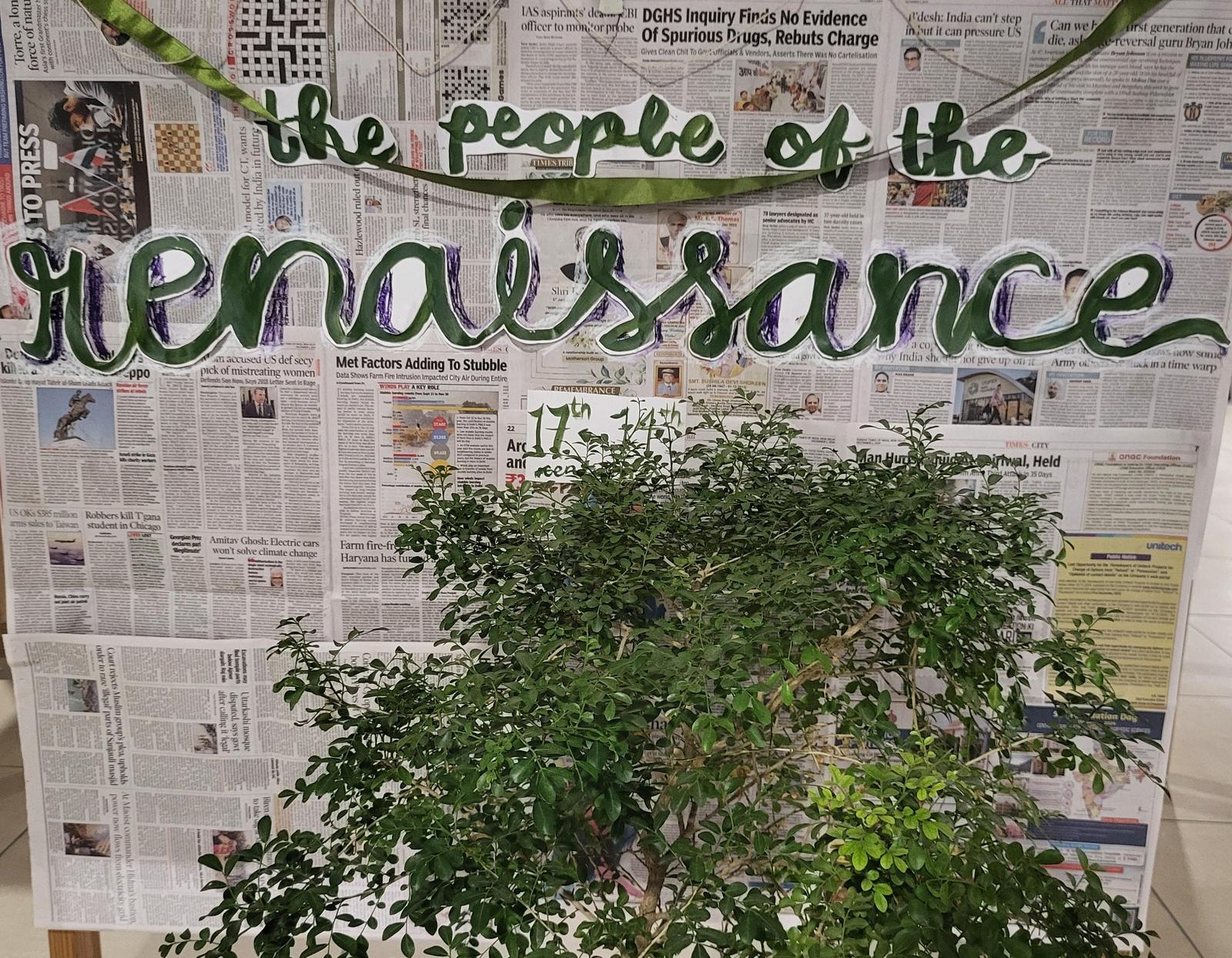
“Whose Renaissance was it?”

A decentring of the standard Eurocentric account, built from primary sources rather than a textbook summary.

Written up by Vidya Viswanathan, facilitator.

Grade 5 · Language

“What is a poem for?”

A poetry unit that had to be abandoned and restarted.

The facilitator’s carefully prepared scaffolds produced a room of compliant, disengaged children. She published that under her own name. A school where an adult can write that down is a school where a twelve-year-old can say it too.

Grade 7 · Purpose

“Can a toilet work without water?”

A waterless toilet, working as a demonstration model.

A stationary installation remains at feasibility stage. Purpose Projects reliably produce good prototypes and unreliably produce implementations, and we would rather say so.

Grades 8–10 · Dialogue

“Can you argue a position you disagree with, properly, before you answer it?”

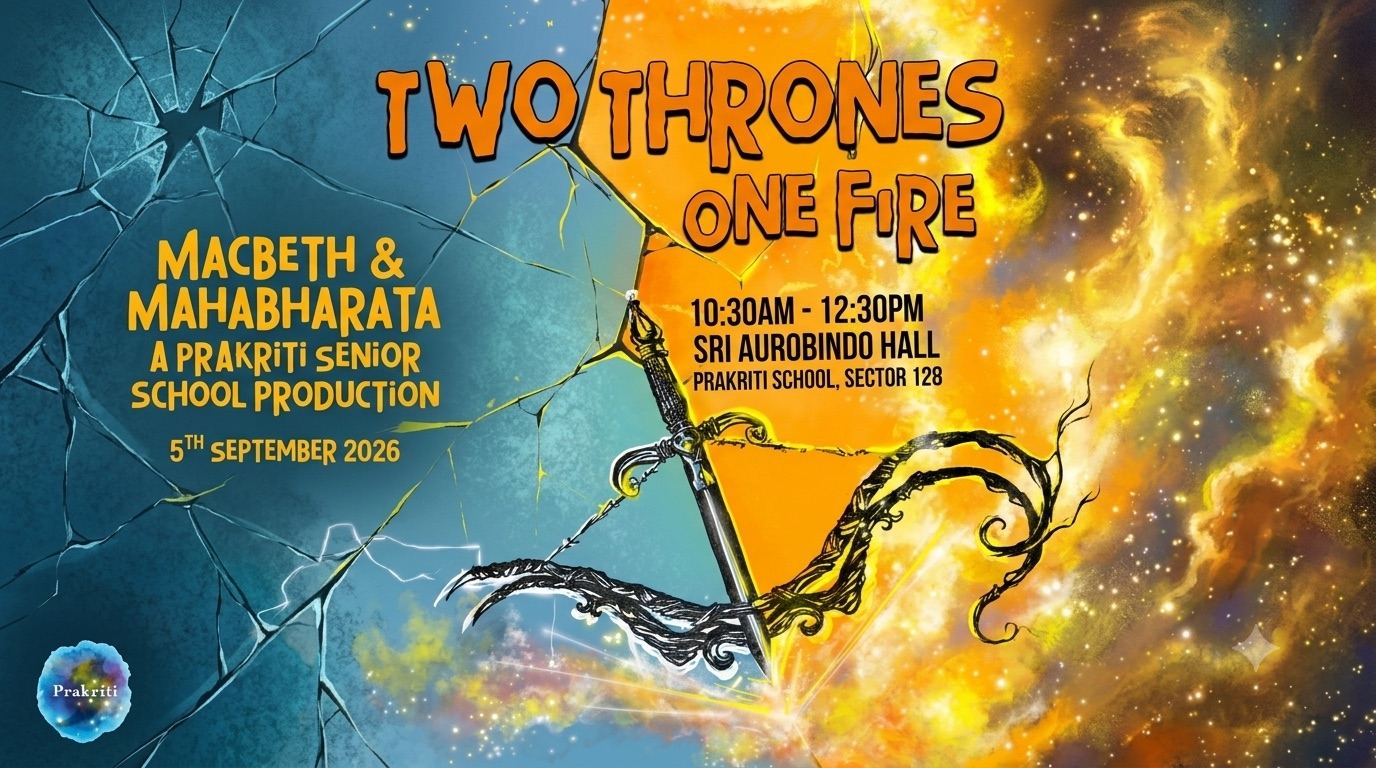
Hocokah 2026 — Socratic dialogues with seven participating schools. No winner is declared.

Built on purva-paksha: state the other position properly first.

Grades 11–12 · Career

“What happens when the work has consequences outside school?”

Discovery Projects, Guilds and internships — seven named senior-school placements with a partner organisation, a workplace, an examiner, a public.

The point is the consequence, not the certificate.

Middle · Outdoor

“What can you only learn by leaving?”

Majkhali — a rural immersion, written up by the two facilitators who ran it.

Kavita Tiwari and Mohit Kwatra, November 2024.

Grade 11 · Arts

“Photograph something true.”

Selected by open call into a twenty-project international children’s exhibition at the Chennai Photo Biennale, alongside work from the UK, Turkey, Guatemala, South Africa, Cambodia and Gaza.

Open call. Not an invitation, not a school quota.

Parents, in their own words

Attributed. Unedited except for length.

“Prakriti is a place where the children can just be. Didis and bhaiyas have understood him deeply as a person, rather than just a face in a crowded class.”

Arunima Jain · mother of two, eight years

“When you join, not only do you enrol your child — you enrol yourself in a journey of learning and unlearning.”

Sumi Tandon · mother, Grade 1

“The boy who struggled to read past a page now reads four or five books a day, and keeps a daily journal of his inner weather. All this in six weeks.”

Meera George · mother, home-school support

“The pedagogy helps our kids start questioning, explore reasons, research and get into discussions — and it enables parents to keep pace.”

Dheeraj Jain · father, Grade 6

“There was something reassuring about this place from the moment we arrived. Six years later it is practically his second home.”

Shashank Singh · father, Grade 3

“The celebration of failures, mistakes, trials and retrials seems to be a valuable life skill imbibed.”

Sangeeta Gupta · on the Grade 6 STEM exhibition

Learners, in their own words

Children who are never compared can describe themselves accurately.

“I realized that I tend to speak a lot, which might not leave enough space for others to express themselves. I really want to work on this.”
Zoey · Grade 7 · self-assessment
“Every young student should have the opportunity to take their creative invention out into the world, and should open it for people to see.”
Grade 10 learner · on filing her patent
“We do feel that there were a few loose ends on our part.”
Aasta · Grade 11 · on her own project
Three commitments

Not values. Three promises you can hold us to.

Your child will not be anxious here

Twenty-five to a class. No marks before Grade 6, no rankings ever, no class topper, no comparative medal on Sports Day. Bubble time any day they need it. If a facilitator cannot describe your child’s inner weather by October, we have failed.

Your child will still be examined properly

Every exam they will ever face tests application and reasoning. Cambridge gives us the structure for teaching it and then examines it, so we are obliged to. Why we chose Cambridge →

We will talk to you about your child, not your child’s marks

Our parent meetings set aside time for tantrums, sleep, eating, friendships — what is actually going on at this age. You are not buying a service. You are joining the people raising your child.

The obvious objection

“A school can only afford this by giving something up.”

Cambridge IGCSE, 2025–26. Externally marked, by people who have never heard of us.

88% at A*–C

Against 80% worldwide for the same subjects. Eight points clear.

11% A* in First Language English

Against 9.8% worldwide — taken by 18 of 22 learners, so close to the whole cohort.

Twelve of twenty-two

Graded A*–C in every single subject they sat.

This year’s leavers went to Shiv Nadar University, Ashoka, Krea, ATLAS SkillTech and FLAME.

Outcomes

The honest test of a progressive school is what happens when a child leaves it.

  • 10

    Cambridge IGCSE at school

  • 12

    AS & A Levels

    Recognised worldwide and by Indian universities through the Association of Indian Universities.

  • →

    Learners who move mid-way settle without gaps

    The curriculum is aligned to both Cambridge outcomes and India's National Curriculum Framework.

  • ASSET

    Above-average learning levels

    Against a national sample of over a lakh children.

  • 0

    Rankings published

    Learner-centred systems do not measure children against each other. Ours reach the same levels — without being ranked on the way.

The inaugural graduating class · 2025–26

The first learners to finish Grade 12 here.

As the school announced them: the learner, the course, and the universities on the card.

Recognised by
2025 · FICCI & ARISE

Recognised for Indian Knowledge Systems

The award came the same day as a whole-school performance tracing India's sense of inquiry through the Sindhu civilisation's knowledge of materials, Nalanda's acceptance of debate, and tribal resistance to colonial force — then asking what AI and robotics do to us, and what humanism might restore.

Read the school's account →

Hocokah

Dialogue with other schools

Prakriti hosts a non-competitive dialogue gathering for Grades 8–10 from schools including Shiv Nadar School, The Mother's International School and Seth M.R. Jaipuria School. Built on inquiry into the participants' own questions, in the tradition of purva-paksha.

An account of Hocokah →

From the journal · Roots of All Beings

The latest three, written from inside the classroom.

Read the whole journal →

Get the next one by email.

Free. Subscribing is not an enquiry — nobody will call you.

Form not showing? Subscribe on Substack →

The strongest evidence is seeing it.

Register for an open house