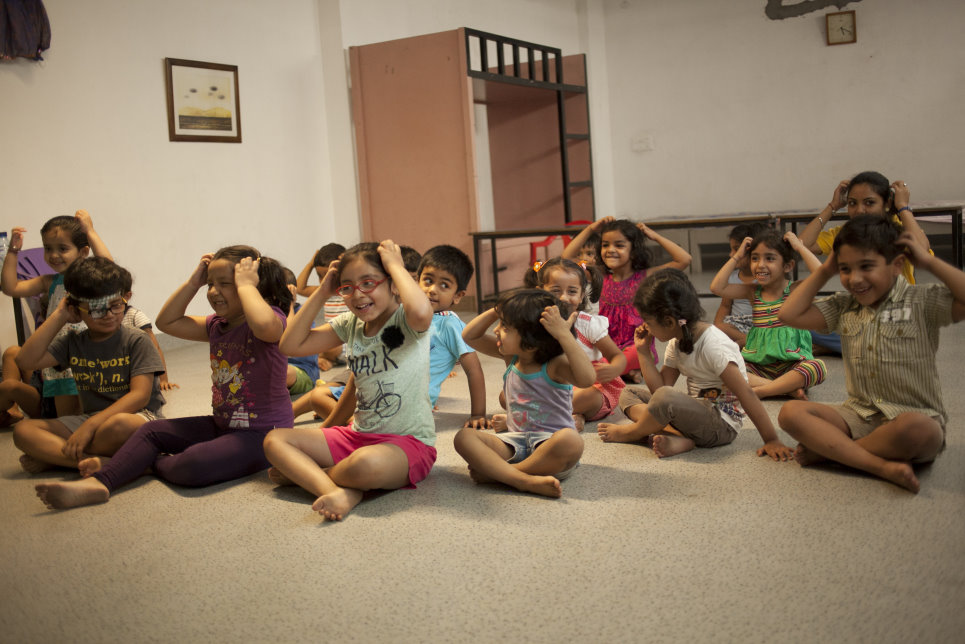
Me, and my senses · Blue, Green, Yellow, then Grades 1–2 · ages 2–7Early Years
“Will they be safe here, and will they be happy?”
At three, the whole curriculum is one adult for every seven children.
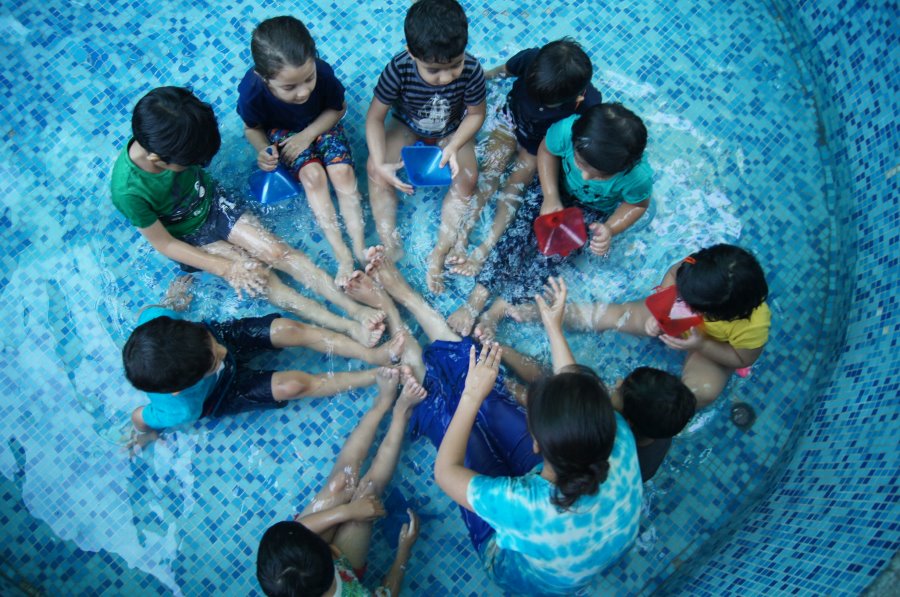
Sand, clay, mud, water, natural colour, and somebody who notices when your child is having a bad morning. No exams. Nothing is compared.
Our early years run as three groups before Grade 1 — Blue (nursery), Green (kindergarten) and Yellow (senior kindergarten). Entry is by age as on 31 March: 2 years 8 months for Blue, 3 years 8 months for Green, 4 years 8 months for Yellow, and 5 years 8 months for Grade 1. Hindi is taught formally from three, English reading and writing from around four and a half, and in practice our learners read, write and speak both by seven. Play is not a break from the curriculum here; the senses, balance and body awareness are the curriculum at this age. Every child can ask for bubble time — a private conversation with a facilitator — on any day, from the beginning.
7:1 One adult to seven children · 2 Languages, both fluent by seven · 0 Exams
Come to an open house →
My neighbourhood, my city · Grades 3–5 · ages 8–10Primary
“Will they learn to read, write and count properly without marks?”
Grade 5 wrote to the District Magistrate about a problem they had seen themselves.
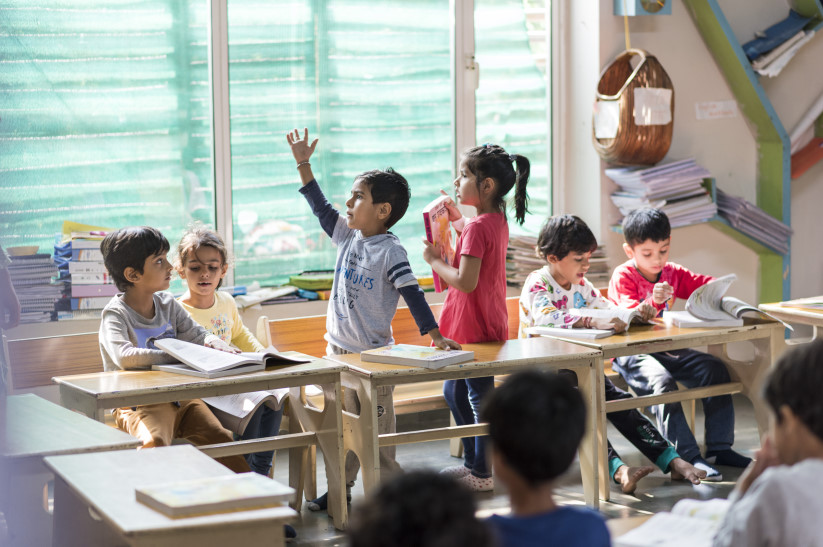
Four projects a year in Environmental Science, drawing on project-based learning models. A farm day every week. Still no marks — and reading, writing and number taught rigorously inside all of it.
Language and mathematics are taught inside the child's own context, then widened: Me and Myself, then My Neighbourhood, then My City. Projects in Environmental Science, inspired by project-based learning models, bring in mathematics, science and languages; they are designed against an eleven-element standard and mapped to Cambridge Primary. We assess thinking rather than memory, and we assess it constantly — we simply do not turn it into a number your child can be ranked by.
4 Projects a year, per grade · 1 Farm day every week · 100% Present at Presentations of Learning
Come to an open house →
My country, and the wider world · Grades 6–8 · ages 11–13Middle School
“My child is coming from another school. Will they cope — and is it too late?”
Children who join us at Grade 6 usually settle within a quarter.
What visiting parents notice first, before anything else, is how quickly those children relax.
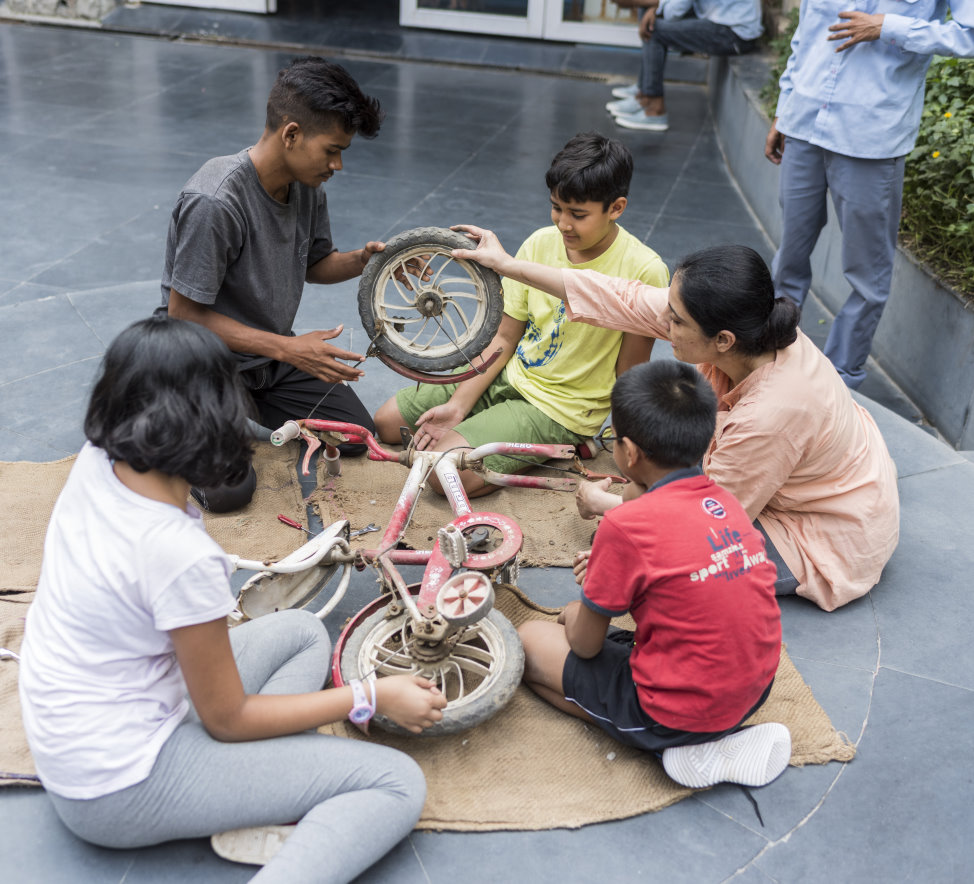
This is the stage most transfers arrive at, and the one where the model is most visible. Indian & Global Studies is our own curriculum — history, civic and political life, geography — with Cambridge Global Perspectives goals folded into it, and the projects of Grades 6–8 run inside it. Personal Projects run twelve weeks on something genuinely theirs, mentored at school and at home; from August the same learners turn outward to the community. Maker tools sit inside the science curriculum.
12 Weeks on a project that is theirs · 2–3 Field visits a year, besides expeditions · 0 Ranks, still
Talk to us about transferring in →
Examined by the world · Grades 9–10 · ages 14–15IGCSE
“Is my child actually ready for an external examination?”
88% of our IGCSE grades were awarded A*–C. The world figure for the same subjects is 80%.
The Cambridge IGCSE course runs across Grades 9 and 10, ending in examinations marked externally, by people who have never heard of us.
We run Cambridge at a humane pace: a manageable number of subjects, real choice of combinations, examinations spread across cycles rather than concentrated in one series, and the long break left alone. Results are still never published to a class. Reports go to your family and nobody else. There is no topper.
88% At A*–C, against 80% worldwide · 11% A* in First Language English, against 9.8% · 12/22 Graded A*–C in every subject sat
Ask about joining at Grade 9 →
Consequences outside school · Grades 11–12 · ages 16–18Senior School
“Which subjects, and which university?”
A Grade 10 filed a patent. A Grade 11 was selected by open call into an international exhibition.
Cambridge AS & A Levels, with subject blocks built around actual enrolment each year — so physics with art and design survives instead of being timetabled out.
Discovery Projects, Guilds and internships put the work where it has consequences outside school — a partner organisation, a workplace, an examiner, a public. This year's leavers went to Shiv Nadar University, Ashoka, Krea, ATLAS SkillTech and FLAME. Cambridge qualifications are recognised internationally and by Indian universities through the Association of Indian Universities.
7 Named senior-school placements · AIU Equivalence for Indian universities · 5 Universities this year's leavers went to
Talk about subject combinations →
Bridge — any age · Special needs, K–12 · ages anyBridge
“My child needs support. Will they be included, or just admitted?”
Included, in the mainstream classroom, with the specialists in the building.
Special educators and behavioural, occupational, voice and speech therapists on staff. Around 50 learners receive one-to-one therapy at school.
Only a small number of learners are integrated into any one class, so the support stays real. Mild needs are met in the classroom through modification and accommodation. We think the effect on every other child in that room is one of the most valuable things we do.
~50 Learners with one-to-one therapy at school · 5 Kinds of specialist on staff · All Sports day, theatre, festivals
Tell us about your child →